

Winterizing Pool: A Technical Process with Different Rules Across Europe’s Climates
26.11.2026
Martin Býšek
Why isn’t there a single universal guide?
What works reliably for a pool in the mild Western European winter can result in costly repairs in Nordic or continental freezes. The starting point for any winterization procedure is the climate zone in which the pool is located. Europe offers extraordinary diversity in this regard. From the oceanic west in the United Kingdom, Ireland, and France, through the transitional center encompassing Germany, the Czech Republic, and Austria, to the continental east. The cold continental and subarctic climates of the Nordic countries—Sweden, Finland, and Norway—pose entirely specific challenges. The same applies to mountainous regions across the entire continent.
Closely related to the climate zone are the frost-free depth of the soil and the overall length of winter, which directly determine the level of risk to underground piping and utility shafts. While in milder regions the soil freezes only shallowly and frosts alternate with frequent thaws, in the north and east, frost penetrates to great depths for many months. However, the geological and construction conditions of the specific property, the groundwater level, the nature of the subsoil, and the method of pool installation itself also factor into this equation.
Regardless of geographic location, there is one common rule for proper timing. Don’t go by the calendar—go by the water temperature. The ideal time is when the temperature consistently drops below ten to twelve degrees Celsius. The pool should not be covered for the winter while the water is still warm. Microorganisms multiply easily in warm environments. It is also important to arrange for professional service and winterization well in advance of the first frosts, when technicians are harder to come by.
Basic Preparation Before Winter
Even before choosing the winterization method itself, every pool requires thorough mechanical and chemical preparation. The foundation is careful cleaning of the bottom, walls, skimmer, or overflow channel, and a thorough rinsing of the filter media. When cleaning plastic surfaces, it is essential to use only gentle cleaning agents that will not damage the material’s structure. Once the pool is mechanically clean, it’s time for chemical stabilization of the water. This includes shock treatment, precise pH adjustment, and checking the total alkalinity and water hardness. Finally, applying a suitable winterizing treatment will help prevent the growth of algae and the formation of calcium deposits during the winter.
Passive or Active Winterization?
In practice, two fundamentally different approaches are used: passive and active winterization. They differ in the technical complexity of fall preparation, the level of safety during extreme cold, and winter operating costs. The passive method involves completely shutting down and draining the system with zero energy consumption during the winter, while the active mode keeps the system on standby.
It is essential to distinguish between active winterization and year-round operation. Active winterization is not intended for swimming; its sole purpose is to protect the pool and piping from freezing. Year-round winter operation, on the other hand, places entirely different demands on heating capacity and chemical usage. The decision on which approach to choose should always be based on a combination of the local climate, groundwater conditions, the pool’s construction layout, the possibility of regular monitoring, and, above all, the reliability of the electricity supply in the given location.
Passive Winterization: The Principle of Safe Shutdown
Passive winterization is the safest option for areas with severe frosts and also where continuous monitoring cannot be ensured. A fundamental rule for polymer pools is that they should never be drained for the winter. This is because the water column inside balances the static pressure of the surrounding soil and any groundwater. If it is ever necessary to completely empty the pool, this may only be done as a short-term maintenance procedure lasting no more than a few hours, and only when subsoil conditions permit it. For winterization itself, the water level is lowered only minimally, to the extent necessary based on the layout of the piping and built-in components. When draining chemically treated water, it is important to remember that the active disinfectant components must be allowed to dissipate before the water is discharged into the sewer system or onto the property.
A key step in the passive winterization method is the thorough draining of the piping system, first by gravity and then by carefully blowing it out with compressed air to ensure no residual water remains in the elbows. Winter plugs are installed in the jets, an expansion compensator is inserted into the skimmer, and ball valves are left slightly open after draining to prevent trapped water from remaining inside the valve body, which could cause it to burst if it freezes. All equipment requires the same care. Drain the circulation pump, filter tank, heat pump, solar heating system, and heat exchanger; shut down the electrolysis system and the automatic dosing unit. Sensitive measurement probes must be removed and stored in a storage solution in a frost-free area.
For an overflow pool, the overflow channel and overflow piping must be thoroughly drained. The balancing tank should always remain partially filled to withstand the pressure from the surrounding soil and groundwater. We then protect the pool structure from ice expansion using expansion floats, which we install on the water’s surface; these absorb the pressure generated by the forming ice cover and protect the pool walls from deformation.
Active Winterization and Frost Protection
In milder climates or for fully secured installations, active winterization based on the frost protection function can be selected. The principle is that the pool remains filled, and when the temperature drops, the control system automatically activates water circulation and heating. Flowing water freezes much more slowly than standing water. However, there is a huge difference in energy consumption between simply heating the water to prevent freezing and actually heating it to swimming temperature during the winter, a difference that is also significantly influenced by the quality and type of pool cover.
A technical challenge of active winterization in colder regions is the choice of heat source. Standard pool heat pumps have clear operational limits—their efficiency drops sharply in freezing temperatures, or they shut down completely for safety reasons. In areas with harsher winters, therefore, a heat exchanger connected to the home’s heating system or electric heating provides a more reliable backup. Water chemistry also requires attention, as disinfection in cold water follows different dynamics—for example, salt chlorinators do not function at low temperatures, and water maintenance must be adapted to these conditions.
When it comes to active winterization, seemingly minor details make all the difference. Every pipe running above ground must be thoroughly protected, the utility shaft must not freeze, and the correct placement of the temperature sensor is absolutely essential so that the system responds in a timely manner to an actual drop in temperature at the most vulnerable point in the circuit. Furthermore, these systems often require the installation of a temperature sensor not only in the pool water circuit but also to measure the outdoor temperature. A power outage remains the greatest risk. Active mode should therefore be supported by remote monitoring with immediate notifications, a backup power source if necessary, and, most importantly, a clear procedure for safely checking the system and restarting it once power is restored.
Protection of Built-In Components and Winter Covers Under Snow Loads
A separate consideration is the protection of all fixtures integrated into the pool structure—jets, skimmers, underwater lights, and counter-current systems. Each of these elements represents a point where trapped water could cause the fixture housing to rupture or damage the seals.
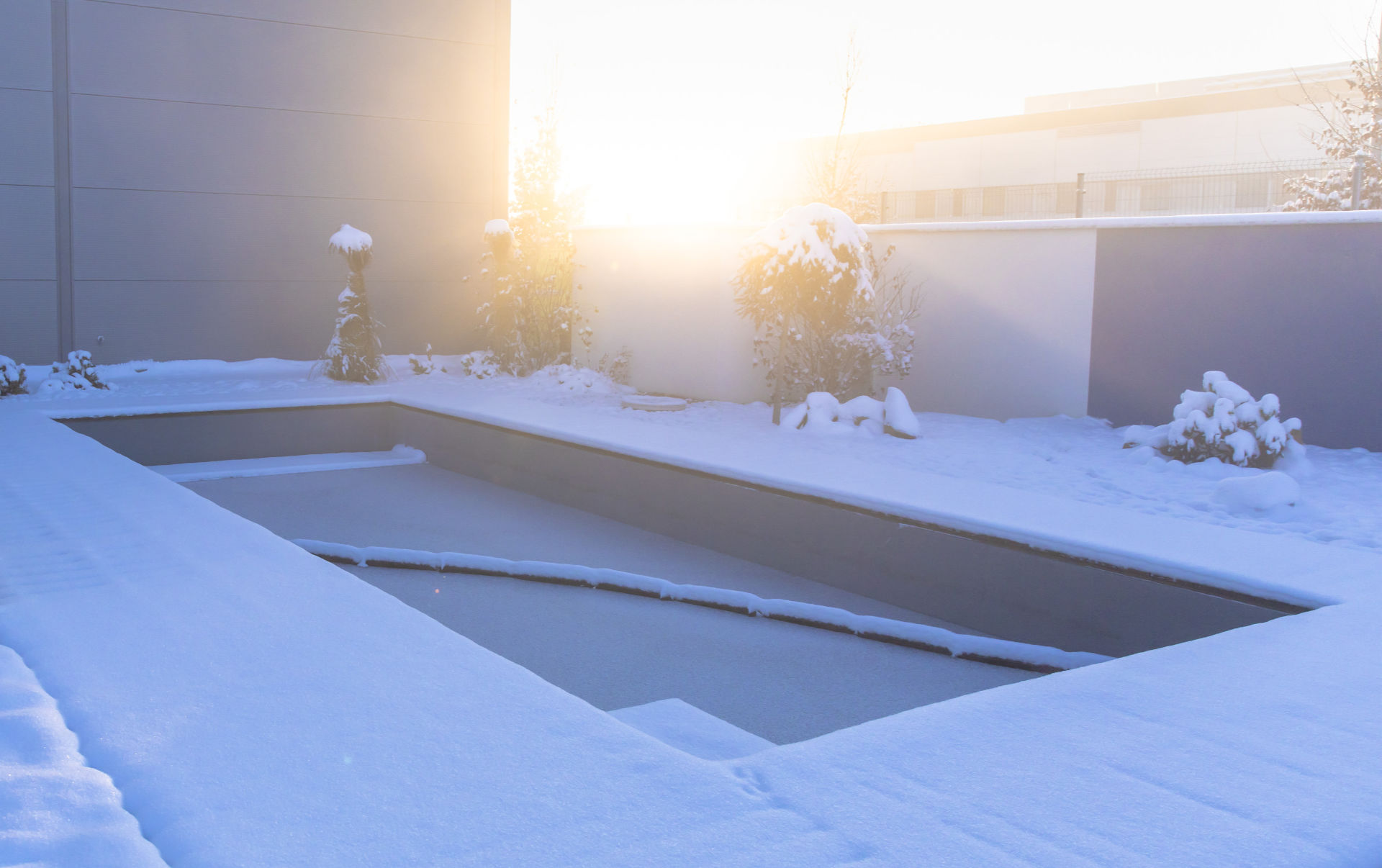
The choice of winter cover must always take local snow loads into account. While a high-quality winter cover protects the water surface from debris and light, a pool enclosure mitigates temperature fluctuations and reduces freezing, but requires monitoring of load-bearing capacity during heavy snowfall. Slatted covers require special caution, as they are not designed to withstand the weight of ice and wet snow.
For winter covers, proper anchoring and careful handling in freezing conditions are equally important, as both plastic and fabric materials become brittle in the cold. Furthermore, any cover must, above all, prioritize the safety of children and pets around the pool throughout the winter.
Utility Shaft and Electrical Wiring
Another vulnerable point in the entire pool system is often the utility shaft. For plastic shafts buried in the ground, similar structural rules apply as for the pool itself—a high groundwater level can damage an empty or inadequately secured shaft, so it is crucial to ensure protection against groundwater and shaft flooding. A flooded shaft poses an immediate threat to the pumps and control electronics.
Before winter, it is advisable to inspect the entire electrical installation, including the proper functioning of the ground-fault circuit interrupter (GFCI), which ensures safety in the event of moisture or condensation. Protection against rodents is an often underestimated but, in practice, very common problem. The warm and quiet environment of a utility shaft attracts mice and martens in the winter, which can destroy wiring and insulation materials; therefore, it pays to thoroughly seal all openings.
Regular Winter Inspections Are Key
Simply winterizing the pool physically does not guarantee that everything will be in order come spring. During the winter, it is important to check the water level at regular intervals, as heavy rain or melting snow can cause it to rise back toward the structures. Conversely, an unexpected drop in the water level signals a possible leak. During heavy snowfall, it is necessary to promptly remove heavy snow from the pool enclosure or cover, and when the pool is in active mode, continuously monitor the operation of the equipment. An emergency inspection should always follow a windstorm, a severe thaw, persistent rain, or a power outage. It is a very good practice to maintain simple winter documentation—a practical checklist, photographs of the technical infrastructure, a record of the positions of individual valves, and a precise list of installed winter plugs. Such records will facilitate the spring startup and are also of crucial value, for example, when dealing with insurance claims for frost damage.
Post-Winter Inspection and Common Mistakes
Once the worst of the frost has passed and temperatures begin to rise, it’s worth conducting a thorough post-winter visual inspection before the actual spring startup. Focus your attention on the condition of the walls, welds, built-in components, pool edge trim, and the current water level. Detecting minor irregularities early will help resolve complications when restarting the system. Most winter damage does not result from extreme weather but rather from errors in the winterization process. These include completely draining the pool for the winter, covering the pool prematurely while the water is still warm, leaving pH and ORP probes exposed to freezing temperatures, failing to open ball valves, or relying too heavily on a heat pump during severe frosts without a backup heat source.
Carefully performed winterization is the best investment in a good night’s sleep during the freezing months and in a quick start to the new swimming season.
Frequently Asked Questions
Do I have to drain the pool for the winter?
No, a thermoplastic pool does not need to be drained for the winter. The water inside balances the pressure of the surrounding soil and groundwater; complete draining is permitted only in exceptional cases and for a short time during maintenance, for a maximum of a few hours.
When is the right time to start winterizing?
As soon as the water temperature consistently drops below 10 to 12 degrees Celsius, but before the first severe frosts arrive.
Is a regular cover enough for winter?
A standard summer solar cover isn’t sufficient for winter. You’ll need a full-fledged winter safety cover designed to withstand local snow loads and properly anchored, or a suitable pool enclosure.
Can the heat pump stay outside over the winter?
Yes, provided that it is thoroughly drained, disconnected from the power supply, and protected according to the manufacturer’s instructions during passive winterization. In active mode, it is necessary to observe its minimum operating temperature and ensure a backup heat source.
What should you do during heavy snowfall?
Heavy and especially wet snow must be removed from the roof and the winter cover continuously and carefully to prevent overloading the structure or damaging the cover.